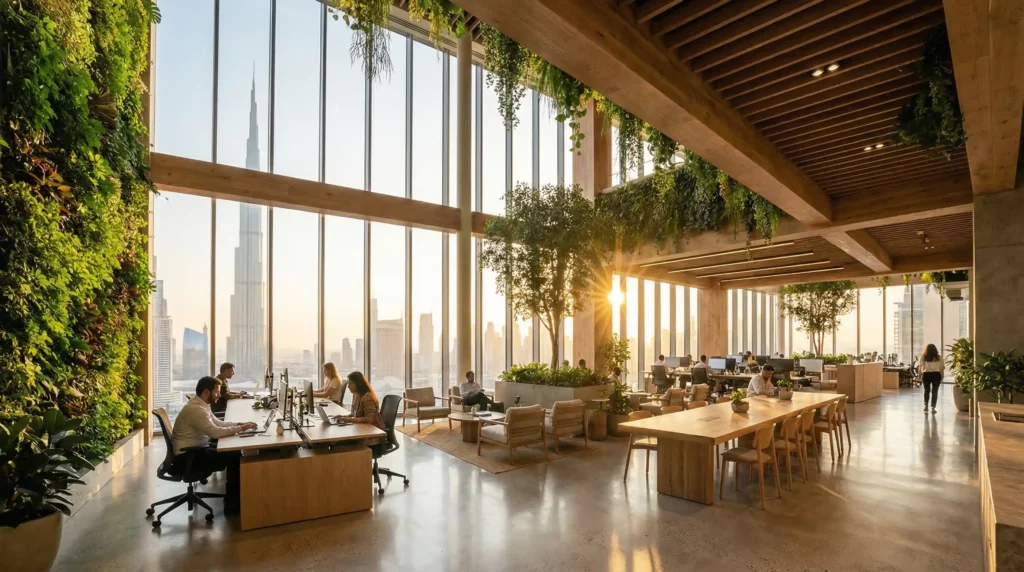
A health-focused workspace integrating natural light, plant systems, and optimized ventilation in Dubai.
QUICK ANSWER
Indoor air in UAE buildings can be 2 to 5 times more polluted than outdoor air. With residents spending over 90% of their time indoors, this makes IAQ the single largest environmental health risk in Dubai. The good news: evidence-based interventions in ventilation, materials, and monitoring can reduce that risk by 40-60% while increasing worker productivity by up to 61%.
How Polluted Is Indoor Air in Dubai Buildings Compared to Outdoor Air?
Indoor air in most Dubai buildings is significantly worse than the air outside, often by a factor of 2 to 5 times. That finding, backed by the U.S. Environmental Protection Agency and repeated in regional studies, surprises most people. We tend to think of buildings as protective barriers. In reality, they are concentration chambers.
The issue is compounded in the Gulf region. Dubai’s climate forces buildings to remain sealed for much of the year. Air conditioning runs continuously, recirculating whatever pollutants accumulate inside. Desert dust carries fine particulate matter (PM2.5 and PM10) that infiltrates through building envelopes. And the materials we build with, from paints and adhesives to flooring and furniture, emit volatile organic compounds (VOCs) for months or years after installation.
According to the Dubai Municipality, key indoor metrics for occupied commercial spaces should maintain CO2 levels below 800 ppm and PM2.5 under 15 ug/m3. In practice, many buildings exceed these thresholds by wide margins, especially during peak occupancy hours when ventilation systems struggle to keep pace.
The implication is clear. If we spend 90% of our lives inside buildings, the quality of that indoor environment is not a secondary concern. It is arguably the primary determinant of occupant health, comfort, and cognitive performance.
The implication is clear. If we spend 90% of our lives inside buildings, the quality of that indoor environment is not a secondary concern. It is arguably the primary determinant of occupant health, comfort, and cognitive performance.
What Does Poor Indoor Air Quality Actually Do to Occupants?
Poor IAQ is linked to headaches, fatigue, respiratory disease, impaired cognitive function, and long-term cardiovascular risk. These are not minor inconveniences. They represent a measurable drag on human health and organizational productivity.
Research from the Harvard T.H. Chan School of Public Health found that workers in buildings with optimized ventilation and lower pollutant levels scored 61% higher on cognitive function tests compared to those in conventional buildings. The study controlled for income, education, and job type. The variable was the building itself.
“We found that for every dollar you invest in improving indoor environmental quality, you get between $6 and $14 back in productivity and health benefits.“
Dr. Joseph Allen, Harvard T.H. Chan School of Public Health
Short-term exposure to elevated VOC levels produces “sick building syndrome” effects: irritated eyes, difficulty concentrating, and a general sense of malaise that occupants often attribute to fatigue or stress rather than the building they are sitting in. Long-term exposure is worse. The American Academy of Sleep Medicine has documented links between poor IAQ and disrupted sleep patterns, which compound into chronic health conditions over time.
In commercial settings, the productivity cost is staggering. Personnel costs typically represent about 90% of a business’s operating expenses. Even a 1% improvement in worker productivity from better air quality can dwarf the entire energy bill of a building. That ratio is what makes IAQ a financial argument, not just a health one.
What Does Poor Indoor Air Quality Actually Do to Occupants?
Dubai enforces multiple overlapping IAQ frameworks, including the Al Sa’fat green building rating, ASHRAE ventilation standards, and the Dubai Air Quality Strategy 2030. Understanding these is essential for any developer, architect, or building operator working in the UAE.
| Regulation / Standard | Scope | Key IAQ Requirements |
|---|---|---|
| Al Sa’fat System | All new buildings in Dubai (mandatory Silver rating) | Pollutant control, natural daylight, ventilation standards, low-VOC materials |
| ASHRAE 62.1-2022 | UAE government buildings (adopted nationally) | Minimum ventilation rates, outdoor air requirements, filtration standards |
| ASHRAE 241 (Airborne Infection) | Healthcare and high-occupancy facilities | Pathogen mitigation through clean air delivery rates |
| Dubai Air Quality Strategy 2030 | Citywide target | 20% improvement in PM10/PM2.5 by 2026; clean air on 90% of days by 2030 |
| Dubai Building Code | HVAC design for new and existing buildings | MERV-8+ filtration, continuous IAQ monitoring in commercial spaces |
Source: Dubai Municipality, UAE Ministry of Energy and Infrastructure, ASHRAE
The regulatory trajectory is clear: requirements are tightening. The Dubai Municipality now mandates continuous IAQ monitoring in commercial and public constructions, using real-time sensors for VOCs, particulate matter, CO2, and humidity. Reports from these monitoring systems are required for both the Al Sa’fat green building certification and the Dubai Health and Safety Code.
For developers, the practical takeaway is that IAQ can no longer be treated as an afterthought bolted onto the commissioning phase. It needs to be a design-stage consideration, woven into architectural decisions about layout, materials, ventilation strategy, and ongoing operations.
🌱 How Well Built Helps
Our advisory tracks cover the full building lifecycle: from preliminary feasibility and wellbeing strategy during design, through non-toxic material selection and air quality management during construction, to performance monitoring and certification support post-occupancy. We translate complex IAQ science into clear, actionable strategies that your team can execute.
What Is the ROI of Investing in Healthy Buildings in Dubai?
WELL-certified buildings in Dubai command 4-7% higher rental premiums and 5-10% higher resale values, while delivering measurable gains in occupant satisfaction and productivity. The financial case has moved past theory. It is now documented across hundreds of certified projects in the UAE.
The International WELL Building Institute reported a 24-fold increase in WELL adoption across the Middle East, with major Dubai projects including Expo City Dubai, Dubai Police headquarters, and developments by Majid Al Futtaim and Nakheel. This is not a niche trend. It reflects a sector-wide recognition that health-certified assets outperform.
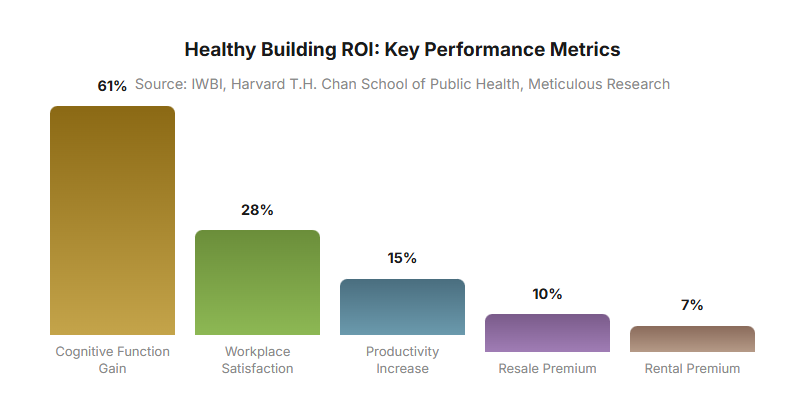
Consider the math. If personnel costs represent 90% of operating expenses, a 10% improvement in productivity has a larger financial impact than eliminating the entire energy bill. The Harvard study estimated $7,500 per person per year from improved ventilation alone. For a 200-person office, that translates to $1.5 million annually in recovered productivity. The cost of the ventilation upgrade is typically a fraction of that figure.
Green-certified buildings in Dubai already show 30-40% lower cooling costs and 20-30% reduced water consumption. Combined with the rental and resale premiums, the payback period for healthy building investments is shortening. Initial cost premiums of 2-7% are decreasing as sustainable construction practices become mainstream in the emirate.
Does Biophilic Design Actually Improve Productivity in Offices?
Yes. Studies consistently show biophilic design increases productivity by 6-15%, reduces absenteeism by up to 20%, and boosts creativity by 15%. The effect is not placebo. It is measurable through cognitive testing, attendance records, and self-reported engagement surveys.
The biological mechanism is straightforward. Humans evolved in natural environments. Our nervous systems respond to natural light, greenery, water features, and organic materials with reduced cortisol production and improved focus. Remove those cues entirely, as most conventional offices do, and stress hormones rise while attention degrades.
A Human Spaces research report found that 70% of employees felt more engaged in workplaces incorporating natural elements like daylight, plants, and views of nature. Meanwhile, offices with biophilic design report nearly 20% fewer sick days. That combination of higher engagement and lower absenteeism is what makes biophilic design a workforce retention strategy, not just an aesthetic choice.
This is particularly relevant in the UAE context. Dubai’s extreme climate makes outdoor time difficult for much of the year. When workers cannot easily access nature outside, the indoor environment becomes the only opportunity to provide those restorative natural cues. Biophilic design, combined with proper daylighting and acoustic treatment, creates indoor environments that compensate for the lack of outdoor exposure.
Is Healthy Indoor Air Quality Too Expensive to Achieve?
No. This is the most persistent misconception in building design, and it is contradicted by the evidence. The assumption that better air quality requires prohibitively expensive systems keeps many developers from investigating the actual cost, which is often far lower than expected.
Research from Johnson Controls and others shows that the energy penalty from enhanced filtration is minimal. High-efficiency filters (MERV-13 and above) add negligible operating cost compared to standard MERV-8 systems. The real costs of poor IAQ, which include lost productivity, increased healthcare claims, and higher tenant turnover, routinely exceed the cost of prevention by factors of 6 to 14 times.
A second misconception is that a single technology can solve the problem. It cannot. Effective IAQ requires a layered approach:
- Ventilation dilutes indoor pollutants with filtered outdoor air
- Filtration captures particulate matter and allergens
- Source control eliminates pollutants at origin through low-VOC materials
- Monitoring provides real-time data to adjust systems dynamically
No single layer replaces the others. Buildings that rely only on air purifiers without addressing ventilation rates, or that specify low-VOC paints but ignore off-gassing from furniture, will continue to have IAQ problems. The strategy must be holistic.
📊 Evidence-Based Results, Not Guesswork
Well Built’s seven advisory tracks, including Indoor Air Quality, Thermal Comfort, Lighting, Acoustics, Biophilia, Health and Safety, and Inclusive Design, work together as an integrated system. We do not treat IAQ in isolation, because buildings do not function in isolation. Our post-occupancy monitoring ensures your building continues to perform, not just on handover day, but for years afterward.
What Should Developers and Building Owners Do Right Now?
Start with measurement, move to strategy, and commit to ongoing monitoring. The three-phase approach we use at Well Built maps directly to how buildings actually get designed, built, and operated.
During Design
- Conduct a preliminary feasibility study that includes climate-specific IAQ risk assessment
- Specify minimum ventilation rates aligned with ASHRAE 62.1-2022 from the outset
- Integrate biophilic elements (daylight access, views of nature, natural materials) into the spatial program
- Set an IAQ performance target, not just energy performance
During Construction
- Mandate low-VOC and non-toxic materials across all finishes and furnishings
- Implement construction IAQ management plans (HVAC protection, dust control)
- Conduct pre-occupancy air quality testing before handover
Post-Occupancy
- Install continuous IAQ monitoring with real-time dashboards
- Establish quarterly performance reviews with occupant feedback
- Pursue WELL or Fitwel certification for third-party validation
- Review and maintain HVAC systems on evidence-based schedules, not calendar-based ones
The global healthy buildings market is projected to reach $71.5 billion by 2032, growing at 4.9% annually. This is not speculative. It reflects documented demand from tenants, investors, and regulators who have recognized that building health is a prerequisite for occupant performance. The developers who act now will hold differentiated assets. Those who wait will be retrofitting later at higher cost.

Benazir Noor Mohamed
Co-Founder, Well Built Healthy Buildings Consultancy
Benazir brings over a decade of practice in the built environment, spanning design, execution, and performance of complex projects. Mentored by Pritzker Laureate B.V. Doshi and serving on the advisory board of the International WELL Building Institute, she is a passionate advocate for human-centric, health-forward architecture. Her expertise lies in harmonising visionary design intent with operational rigor. She completed advanced studies at University College London.
Connect on LinkedIn →: Why Indoor Air Quality Is the Biggest Overlooked Risk in Dubai Buildings